Quick Answer: Custom software development for IoT means building the firmware, connectivity, cloud backend, and mobile or web app together as one system, rather than bolting Bluetooth or Wi-Fi onto a generic app. It requires expertise across hardware constraints, data pipelines, and security, not just app design.
What Custom Software Development for IoT Actually Means
Custom software development for IoT is the practice of building firmware, connectivity, cloud infrastructure, and user-facing apps as one coordinated system designed around a specific device and business goal. This differs from off-the-shelf IoT platforms, which offer pre-built dashboards and generic device templates that rarely fit a company's exact sensors, data volume, or compliance needs.
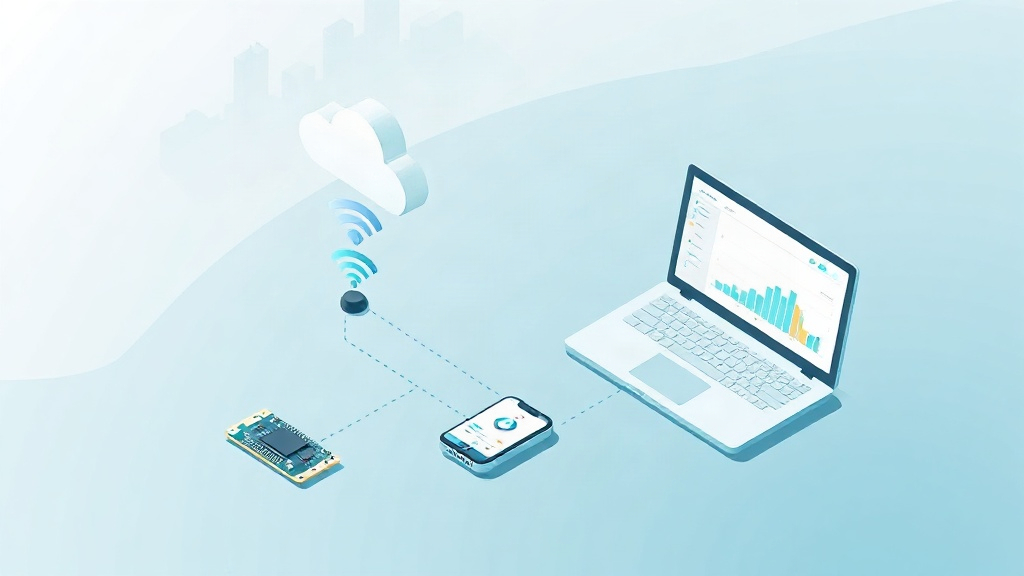
A working IoT product has four layers that must talk to each other correctly: the device or firmware layer that reads sensors and controls hardware, the connectivity layer that moves data (Wi-Fi, cellular, LoRaWAN, Bluetooth), the cloud backend that stores and processes data, and the mobile or web app that people actually use. Each layer has different failure modes, so each needs deliberate engineering.
For teams moving from planning to development, an important decision is finding a partner with experience across the parts of the IoT system their product requires.
An app interface is only one part of the build. Firmware, connectivity, and cloud infrastructure also need to work together, so ask prospective partners how they approach the complete system, including the device-to-cloud data flow.
A partner offering custom AI software solutions and digital product development should be able to explain how these components fit together and where the main technical challenges are likely to arise.
What's Included in IoT Application Development Services
IoT application development can involve four technical layers. When evaluating a provider, ask how its team will handle each layer your project requires, from device firmware to the user-facing app.
Device/firmware layer. This is the code running directly on the hardware, managing sensor reads, power consumption, and local processing before data ever leaves the device. Firmware decisions here, like how often a sensor polls or when it batches data, directly affect battery life and data accuracy later in the pipeline.
Connectivity and middleware. Internet of things app development services need a protocol choice suited to the use case: MQTT for low-bandwidth telemetry, HTTP/REST for occasional syncs, or LoRaWAN for long-range, low-power sensor networks. Middleware then handles device authentication, message queuing, and reconnection logic when a device drops offline.
Worth Knowing: A device that reconnects and resends missed data correctly is often a bigger engineering challenge than the initial connection itself, and it's where many lightweight IoT builds fail first.
Cloud backend and data pipeline. An IoT app development service needs a backend that can ingest high-frequency data, store it efficiently, and run analytics or alerts without lag. This includes time-series databases, data retention rules, and APIs that the app layer queries.
Mobile/web app layer. Internet of things application development services finish with the interface people use to monitor devices, set thresholds, and receive alerts. This layer should be built to the same custom UI/UX standard as any other product, not treated as an afterthought once the hardware pipeline works.
The IoT Solution Development Process, Step by Step
IoT solution development follows a sequence where skipping steps creates rework later, not faster delivery.
- Discovery. Define the device's purpose, data points needed, connectivity environment, and regulatory requirements (healthcare and industrial IoT often carry compliance obligations).
- Prototyping. Build a working proof of concept with real hardware, even a single device, to validate sensor accuracy and power draw before committing to a design.
- Firmware development. Write and test the device-level code, including over-the-air update capability so bugs can be fixed after deployment.
- Cloud integration. Connect the device to a backend that can handle the expected data volume, not just the pilot's volume.
- Testing. Run field tests under real conditions: poor signal, battery drain, temperature extremes, not just lab conditions.
- Deployment. Roll out to production devices with monitoring in place to catch failures early.
Projects most often stall at two points: security, when authentication and encryption are treated as a later add-on instead of a design requirement, and scaling, when a backend built for ten test devices can't handle ten thousand in production.
Red Flag: If a development quote doesn't mention over-the-air firmware updates, ask directly. Without them, every bug fix requires physically touching each device.
How to Choose an IoT App Development Company
An IoT app development company should be evaluated on its ability to handle hardware constraints, not just its app portfolio.
Use these criteria during evaluation:
- Can they show firmware work, not just app screens, in past projects?
- Do they ask about your device's power source and connectivity environment before quoting?
- Do they discuss data retention and security architecture unprompted?
- Can they explain how they'd handle a device going offline mid-transmission?
In-house vs outsourced teams. Building IoT products may require skills across firmware, connectivity, cloud infrastructure, and application development. If those skills aren't available in-house, an external development partner can help fill the gaps. Consider how the team will coordinate with your existing engineers, share technical decisions, and support the product after launch.
Portfolio and technical due diligence. When comparing IoT development companies, look beyond interface designs and ask how the underlying system is structured. Architecture diagrams can help you understand how the device, connectivity, middleware, cloud, and app layers interact, and which parts the team will be responsible for.
Ongoing support expectations. Before choosing a provider, clarify what happens after launch: who monitors devices in the field, how firmware updates are delivered, and how data pipeline failures are detected and handled. Make sure the support arrangement matches your product's operational needs.
Insider Recommendation: Ask any prospective partner to walk through a failure scenario, like a sensor sending corrupted data, before you sign. Their answer tells you more than their pitch deck.
Common IoT Project Types and Use Cases
IoT projects span several industries, each with different constraints on connectivity, data sensitivity, and device lifespan.
- Industrial monitoring. Sensors on manufacturing equipment track vibration, temperature, or output to predict failures before they halt production.
- Smart home. Connected devices controlling lighting, locks, or climate, usually over Wi-Fi or Bluetooth with an app as the primary interface.
- Fleet tracking. GPS and telematics devices on vehicles reporting location, fuel use, and driver behavior over cellular networks.
- Healthcare wearables. Devices tracking patient vitals remotely, which typically carry stricter data privacy requirements than consumer IoT.
Different IoT use cases place different demands on the underlying technology. The table below highlights areas to discuss with prospective development partners when deciding whether their experience fits your project.
| Areas to evaluate | Questions to ask the development partner |
|---|---|
| Firmware | Who will develop and test the device-level software? |
| Connectivity | How will the team select and validate the communication protocol? |
| Security | How will device authentication, data protection, and updates be handled? |
| Scalability | How will the system be tested against the expected number of devices and volume of data? |
Choosing a Development Partner for Your IoT Product
Before committing to a provider, review your product roadmap and identify any open decisions around firmware, connectivity, device-to-cloud architecture, and ongoing support. Discuss these requirements with a custom software development partner before finalizing the project scope.


